H2Accelerate make a strong impression at IAA Transportation Hannover
In September 2026, the European automotive sector came together at the IAA Transportation conference in Hannover. Members of the H2Accelerate collaboration alongside other European and global OEMs used the event as a platform to promote future zero-emission vehicles with hydrogen-powered trucks featuring heavily.
H2Accelerate OEMs showcased hydrogen trucks to customers demonstrating the maturity of zero-emission hydrogen trucking
H2Accelerate members showcased the latest developments in hydrogen-powered trucking at IAA Transportation in Hannover, demonstrating the progress being made towards the combined battery-electric and hydrogen-powered solution needed to decarbonise road freight.
For Daimler Truck, IAA Transportation marked 130 years since Gottlieb Daimler invented the first truck in 1896. Alongside this milestone, the company presented the Mercedes-Benz NextGenH2 Truck to the public for the first time. The fuel cell truck represents the next step in Daimler Truck’s development of hydrogen-powered long-haul transport, ahead of the deployment of a small series of 100 vehicles in customer operations from the end of 2026.
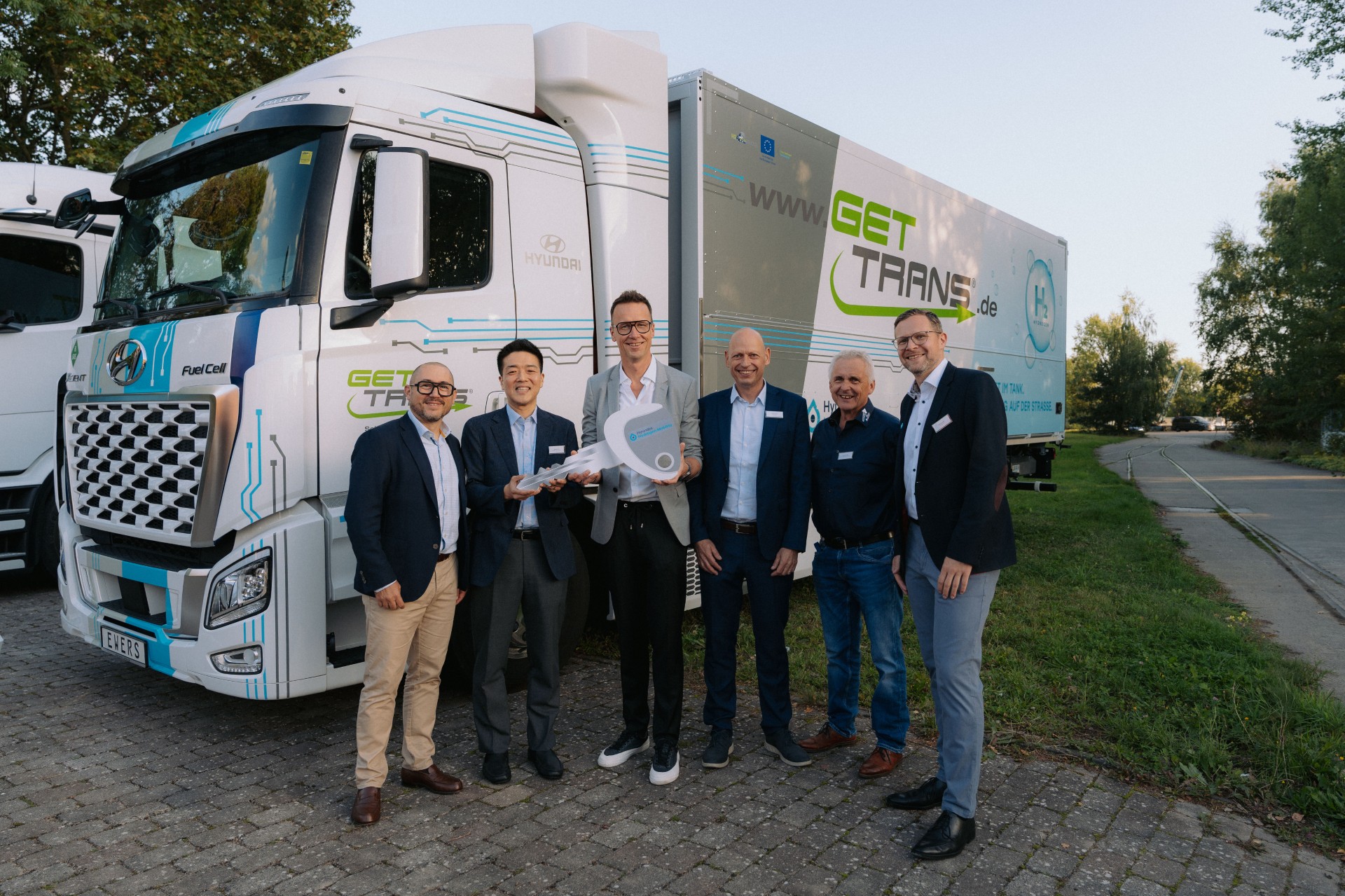
On the eve of IAA Transportation, Hyundai handed over to Gettrans the world’s first fuel cell truck specially developed for beverage logistics. This XCIENT fuel cell truck is part of 125 trucks being deployed under the H2Accelerate TRUCKS project. This bespoke solution is fitted with a body specifically designed for the demands of beverage logistics and will now be deployed in Gettrans’ day-to-day operations. The vehicle showed how an established fuel cell truck platform can be adapted for different commercial applications, building on the almost 170 XCIENT trucks already operating in Europe.
Volvo Trucks also gave visitors the opportunity to experience hydrogen truck technology first-hand. Alongside its wider range of alternative drivetrains, Volvo presented both fuel cell and hydrogen internal combustion engine trucks at IAA, with its fuel cell truck available for selected test drives. The demonstrations provided operators and other visitors with an opportunity to experience the performance of hydrogen-powered heavy-duty vehicles firsthand.
The hydrogen trucks presented and demonstrated throughout IAA Transportation attracted interest from truck operators, fleet managers, policymakers and other industry stakeholders. Together, they provided a practical demonstration of the progress being made by manufacturers and vehicle specialists, as hydrogen truck technologies move from development and early trials towards a broader range of customer operations.
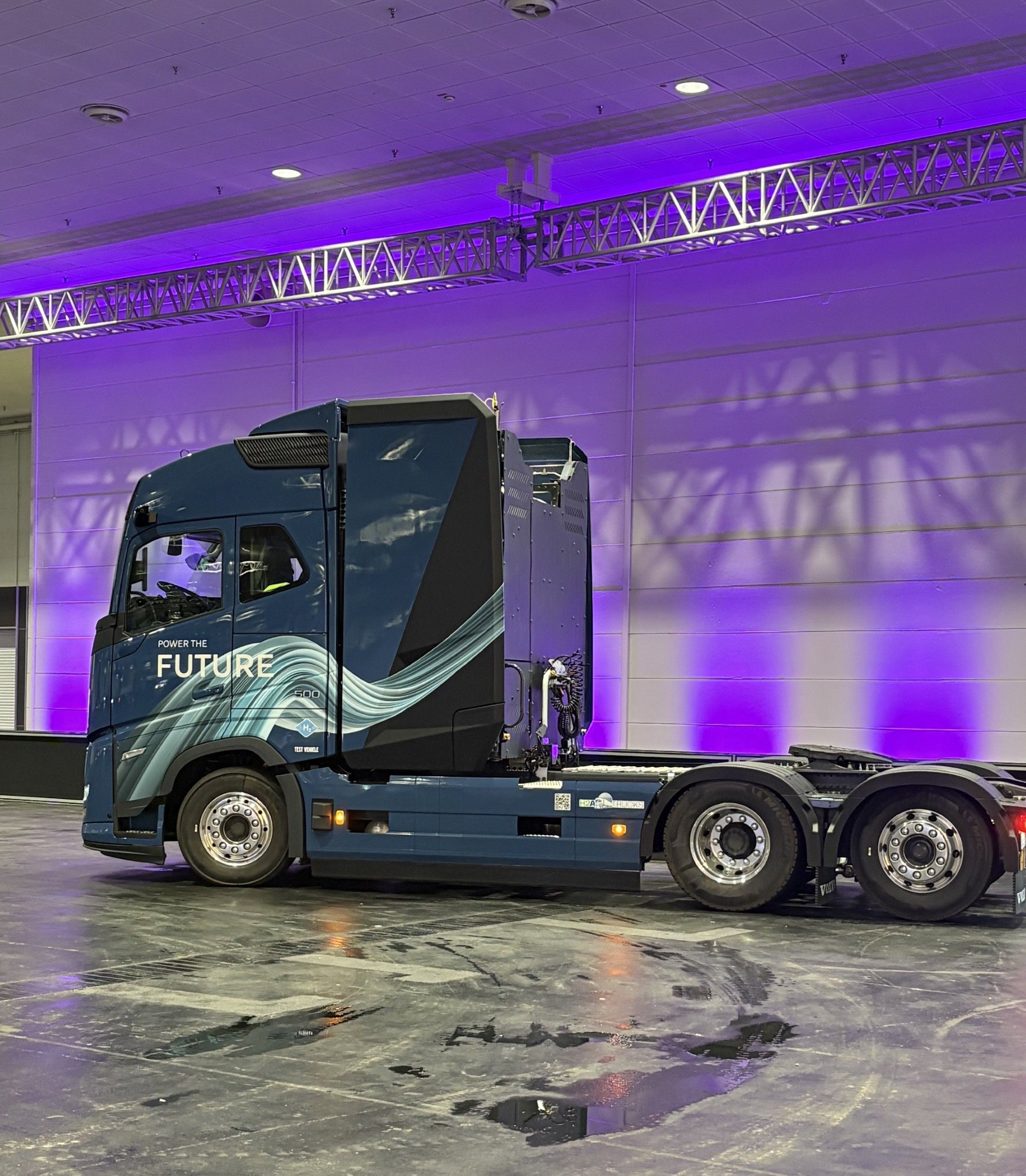
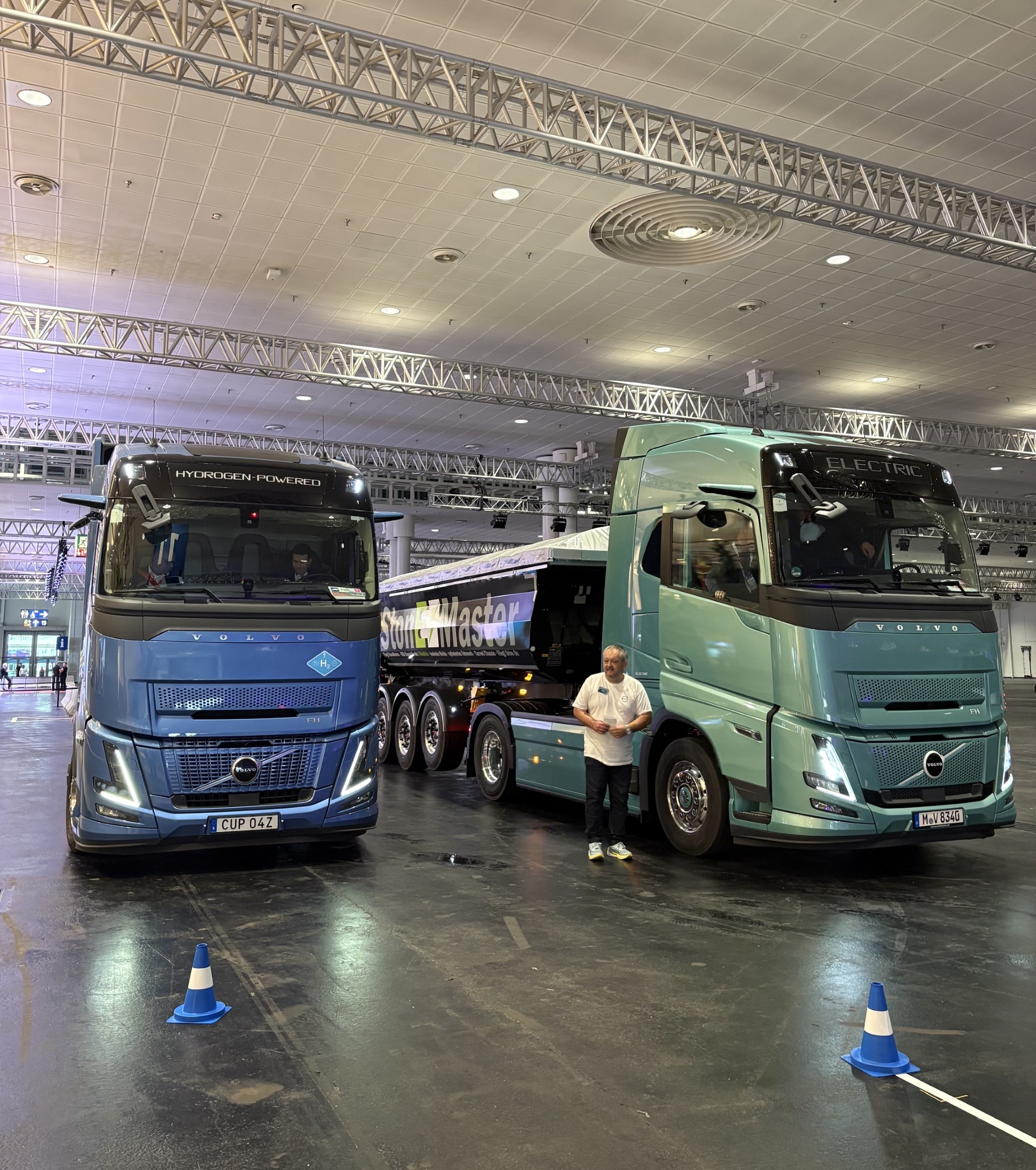
Volvo fuel cell trucks test drives at IAA Transportation, photos by AM Robinson
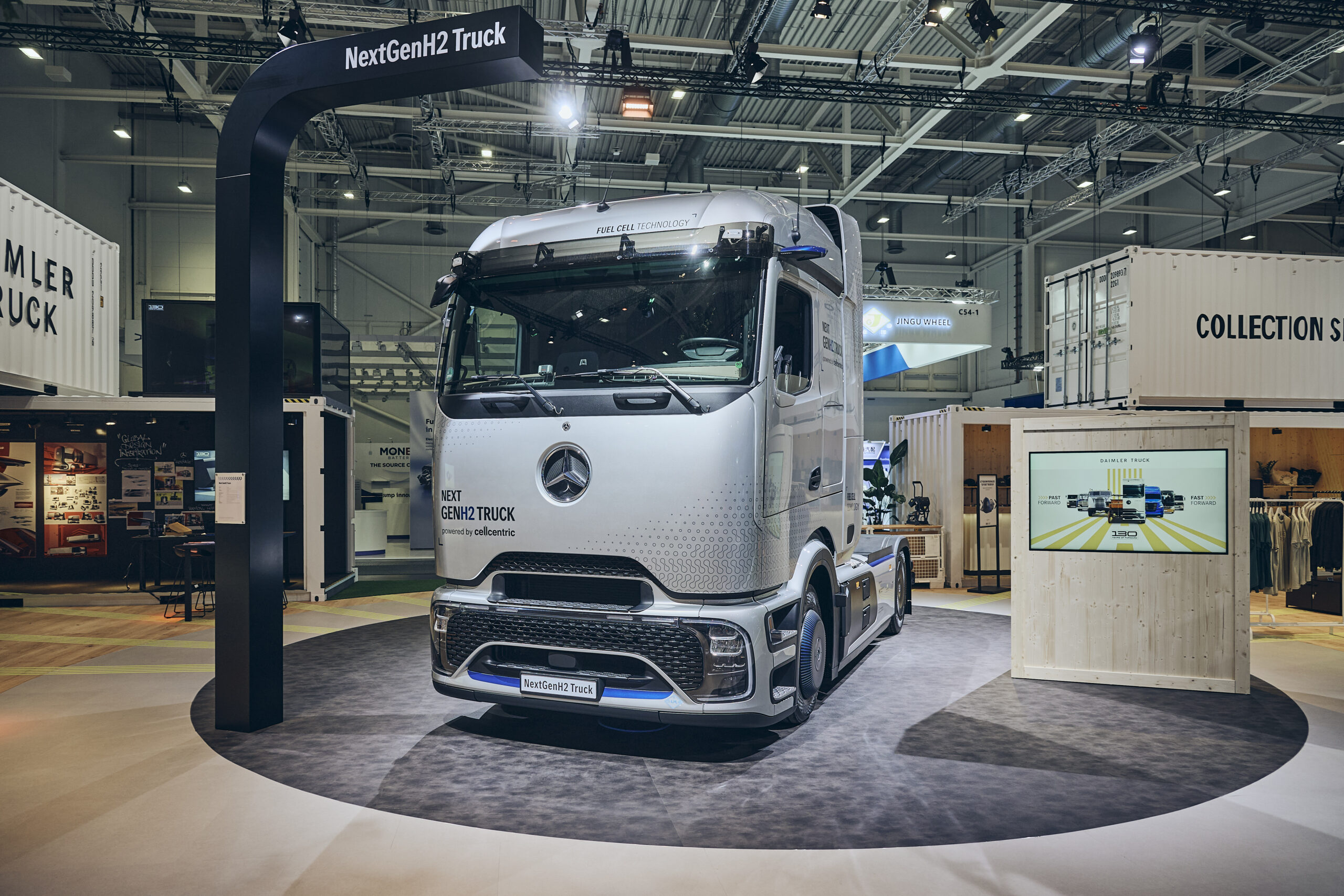
Daimler’s Next GenH2 Truck exhibited on the IAA Transportation show floor
Hyundai Hydrogen Mobility spoke on their successes of their XCIENT Truck, operating since 2020 and recently achieving over 21 million km driven, and around 170 trucks successfully deployed and delivered to customers. The growing fleet is already making an impact, with customers highlighting the truck’s low-emission performance and comfortable driving experience.
“These trucks are magnificent and as drivers, we love driving them because they are good quality. Everything is well thought out.” – Driver at Edeka
“It’s incredible how quiet [the trucks] are. It’s the most silent truck I’ve ever known. My colleagues are going to be very happy with them.” – Driver at Edeka
A strong CEO initiative for hydrogen trucking was announced
A new CEO initiative was launched at IAA Transportation, with many members of the H2Accelerate collaboration participating. Members of the CEO initiative unveiled their plans to accelerate the rollout of hydrogen-powered vehicles across Europe. The initiative highlighted the enabling conditions put in place by the German ecosystem for a scalable deployment of hydrogen trucks by 2030, driven by German government policies and industrial collaboration. The group will use Germany as an operational launchpad and calls for national governments and the European Commission to replicate the German model across Europe to enable the scaling of these solutions across the continent.
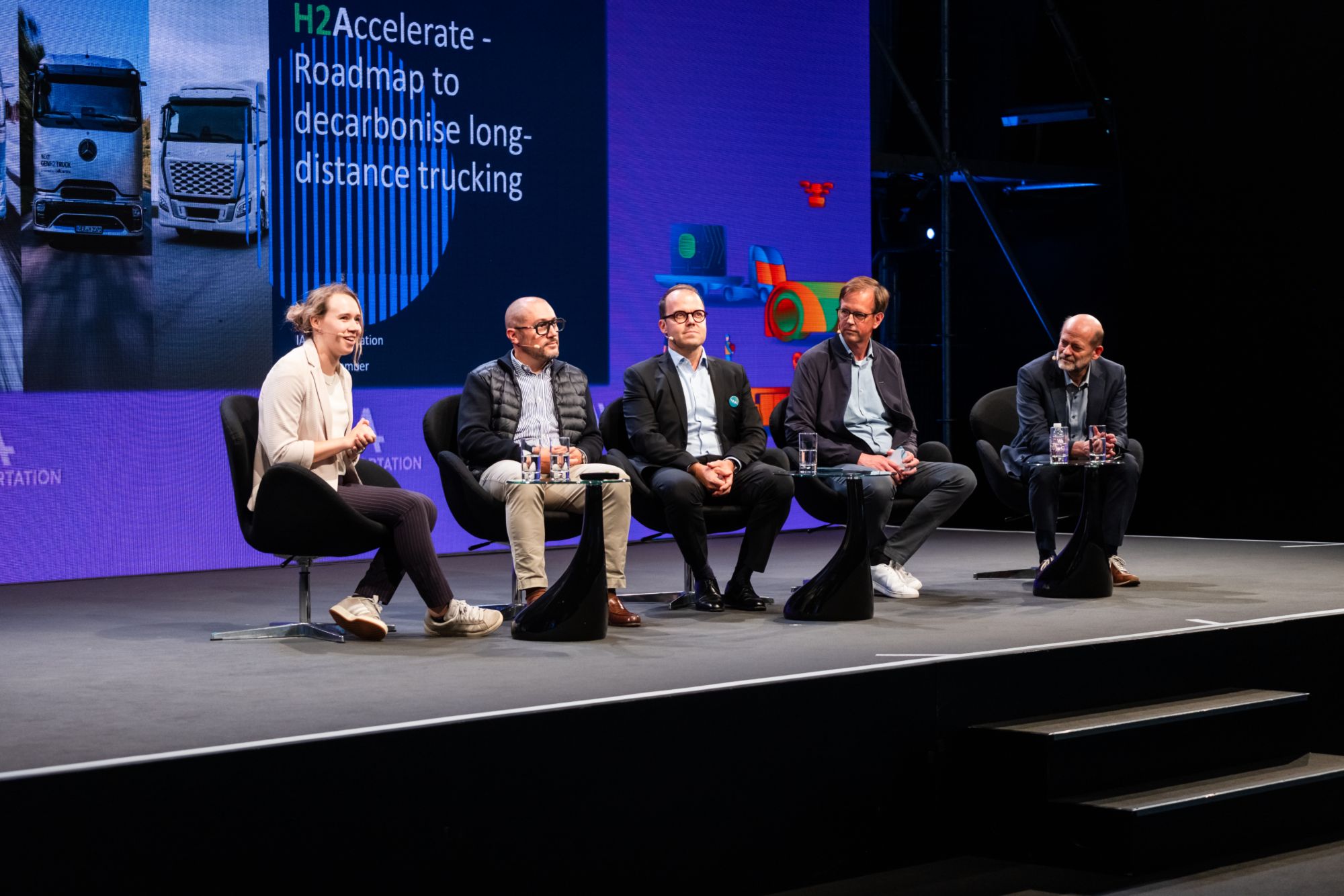
The H2Accelerate Collaboration led a panel on hydrogen trucking
Members of the H2Accelerate Collaboration brought the successes of the event to a strong close with a panel exploring the Roadmap to Decarbonise Long-Distance Trucking, where members celebrated the key success achieved to date and looked ahead to the condition needed to build even greater momentum across Europe’s hydrogen trucking sector.
Speaking on the panel were Charles Cambournac from Hyundai Hydrogen Mobility, Nicolas Garnier from TEAL Mobility, Gregor Frieb from Volvo Truck and Manfred Schuckert from Daimler Truck.
Hannah Bryson-Jones, spokesperson for the H2Accelerate collaboration, summarised some of the progress that has been made recently in the hydrogen trucking sector:
“We’re delighted to see here at IAA Hannover some of the results of [H2Accelerate’s messaging] now coming through, with trucks being demonstrated, the announcement of large-scale funding earlier this year from the German state, and all of our members working together in order to enable these first ecosystems.” – Hannah Bryson-Jones, H2Accelerate spokesperson
Manfred Schuckert, the head of Automotive Regulatory Strategy and International Hydrogen Strategy for Daimler Truck, spoke on their next-generation truck which will be brought into operation later this year:
“You can see at our booth, our latest generation of our fuel cell truck, the NextGenH2 Truck. We will hand over the first vehicle by the end of the year to our customer DACHSER, who plan to operate the truck with an expected yearly distance driven of 220,000km.” – Manfred Schuckert, head of Autootive Regulatory Strategy and International Hydrogen Strategy for Daimler Truck
During the panel, Volvo Group shared a short testimonial video highlighting the positive feedback from customers following their first experiences of trucks on the road. Gregor Frieb, who works on Business Development and Public Affairs for Volvo Group, summarised the early customer experience with the trucks:
“We’re seeing strong interest in the trucks. They’re out on test drives from our IAA booth all day, which is a clear sign that customers are eager to experience the technology firsthand.” – Gregor Frieb, Business Development and Public Affairs for Volvo Group
Alongside the growing number of hydrogen trucks being deployed on the road and encouraging feedback from customers, panellists also highlighted the positive impact of joint funding approaches in Germany and the Netherlands. Nicolas Garnier, CEO of TEAL Mobility, explained how these funding packages are helping to address the need to develop both hydrogen trucks and infrastructure:
“We are seeing very promising package structures in the Netherlands and in Germany, with the SWIM and NOW programmes, where the subsidies are covering and synchronising both sides of the chicken-and-egg conundrum: both the truck and the station.” – Nicolas Garnier, CEO of TEAL Mobility
Charles Cambournac, the Managing Director of Hyundai Hydrogen Mobility Germany, reflected on how Hyundai Hydrogen Mobility have been able to leverage policy support to deploy around 170 hydrogen fuel cell trucks on the road. Charles spoke on the need for continued aligned funding across all Member States to further scale up deployment:
“We invest a lot of money in the production of these trucks, but we need to scale up, and this is where the subsidy helps. It’s important we take the lessons learnt from the first round of subsidy which has been launched and then we scale it up, not in one country, like Germany or the Netherlands, but across Europe” – Charles Cambournac, Managing Director of Hyundai Hydrogen Mobility Germany
About H2Accelerate
H2Accelerate is a collaboration between Daimler Truck, Linde, Hyundai Hydrogen Mobility, TEAL Mobility, TotalEnergies and Volvo Group, working together to accelerate the deployment of hydrogen for long-haul trucking in Europe.