H2Accelerate calls for combined European funding for hydrogen trucks and refuelling stations
The H2Accelerate collaboration has today published the second paper in its policy series. The paper sets out a proposal for adapting future European funding programmes to better support the coordinated deployment of hydrogen-powered trucks and refuelling infrastructure.
Combined funding programmes are already being implemented in the Netherlands and Germany and have been strongly endorsed by industry. Alongside RED III credits and suitable road toll exemptions, these programmes can create a competitive business case for hydrogen trucking. Building on these examples, the H2Accelerate collaboration proposes that future European funding, including the next generation of CEF AFIF, should support hydrogen trucks and refuelling stations together.
Member State funding programmes are showcasing the value of coordinated deployment
Scaling hydrogen trucking requires vehicles and refuelling infrastructure to be deployed in parallel. Refuelling station operators need sufficient hydrogen demand to support investment decisions, while fleet operators need confidence that reliable refuelling infrastructure will be available before committing to hydrogen-powered trucks. To meet this challenge, the Netherlands and Germany have introduced funding programmes designed to support both vehicles and stations within the same projects.
Since 2024, the Netherlands’ Subsidy for Hydrogen in Mobility (SWiM) programme has provided joint capital support for hydrogen refuelling stations and hydrogen-powered vehicles. Across its first two rounds, around €72 million has been awarded to projects supporting approximately 600 hydrogen-powered vehicles and 15 new or expanded refuelling stations.[1]
Germany launched a similar combined funding programme in January 2026, with a total budget of €220 million targeting up to 40 hydrogen refuelling stations and around 400 hydrogen-powered trucks[2]. The programme was more than twice oversubscribed and received applications covering more than 70 high-capacity hydrogen refuelling stations and 455 vehicles and vehicle fleets[3].
Both programmes require cooperation between infrastructure providers and vehicle end-users, helping to align investment across the hydrogen mobility value chain.
[1] Public presentation by RVO, shared July 2026
Nicolas Garnier, CEO of TEAL Mobility said:
“One of the main challenges for hydrogen trucking roll-out is ensuring that vehicles and refuelling infrastructure are deployed in parallel. Station operators need confidence that there will be sufficient demand, while fleet operators need certainty that suitable refuelling infrastructure will be available.
The Netherlands and Germany are using combined funding to help solve this challenge by bringing infrastructure providers and vehicle users together around real deployment projects. There is a strong opportunity to build on these approaches at a European level.”
Siloed European funding is leading to a coordination challenge for hydrogen trucking
To date, European funding for hydrogen trucking has supported hydrogen refuelling infrastructure and hydrogen-powered trucks through separate programmes.
CEF AFIF has played an important role in supporting the development of alternative fuels infrastructure across Europe. Since 2021, approximately €400–450 million has been awarded to hydrogen refuelling infrastructure projects, providing funding for a planned 275 stations. However, funding for infrastructure alone does not guarantee sufficient vehicle demand to support station utilisation. Many of the CEF AFIF supported stations have, as a result, faced deployment challenges in practice. Similarly, European support for hydrogen truck deployment has largely focused on first-of-a-kind demonstration projects rather than broader commercial deployment.
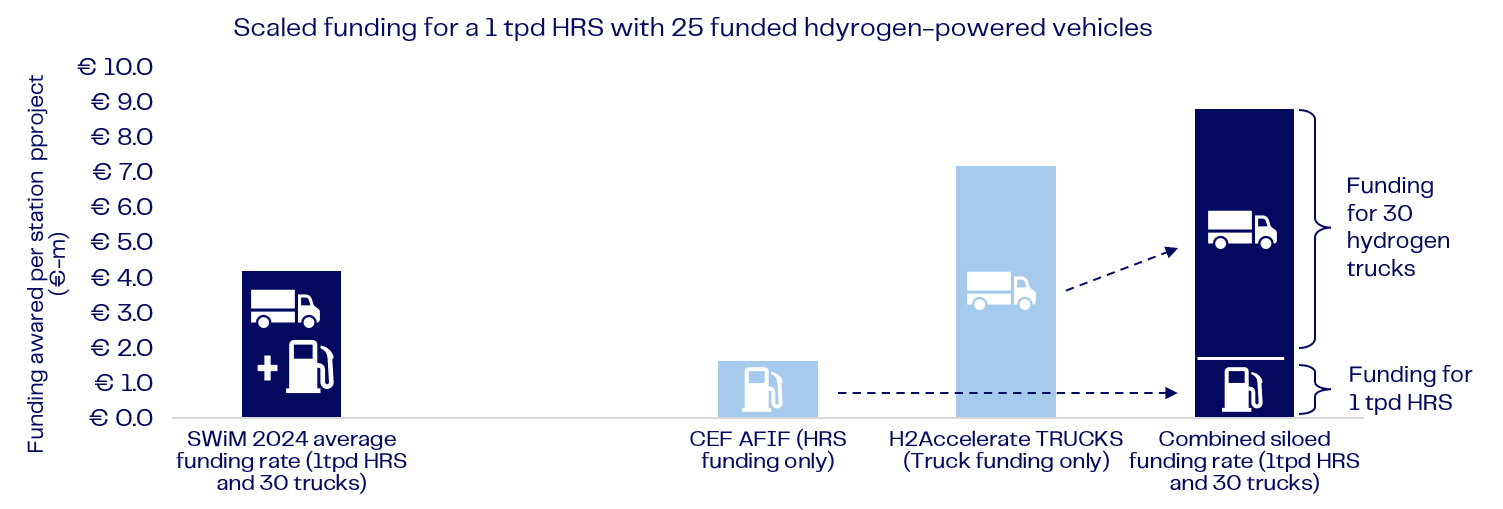
Combined funding schemes are designed to address the coordination challenge of station and vehicle deployment and may also improve the effectiveness of public capital. Based on recent SWiM awards, a package comprising a 1 tonne-per-day hydrogen refuelling station and 30 hydrogen-powered vehicles received approximately €4.21 million in public funding on average. Using recent European infrastructure and vehicle funding programmes as reference points, an equivalent deployment funded separately would require approximately €8.84 million.
These figures are indicative only, as the programmes differ in scale and the technologies eligible for support.
H2Accelerate is calling for a combined truck and station funding model for future European programmes
Drawing on experience from the Dutch and German schemes, H2Accelerate members propose that future relevant European funding programmes should:
- Fund both hydrogen-powered vehicles and refuelling infrastructure;
- Require funded stations and vehicles projects to form joint consortia involving station operators and vehicle users;
- Provide sufficient notice of future funding calls to allow strong project consortia to form;
- Promote flexibility across vehicle classes, hydrogen truck technologies and refuelling solutions; and
- Set clear deployment timelines to ensure that funding translates to operational vehicles and infrastructure.
Hannah Bryson-Jones, Spokesperson for the H2Accelerate collaboration, said:
“European funding has already made important contributions to the development of hydrogen refuelling infrastructure. The next step is to ensure that infrastructure and vehicle deployment reinforce one another and drive a coordinated scaling of the sector.
Bringing fleet operators, station developers, hydrogen suppliers and vehicle manufacturers together around coordinated projects can reduce risk across the value chain and help public funding translate more quickly into trucks and stations in operation.”
The full paper can be downloaded from the H2Accelerate website here.
About H2Accelerate
H2Accelerate is a collaboration between Daimler Truck, Linde, Hyundai Hydrogen Mobility, TEAL Mobility, TotalEnergies and Volvo Group, working together to accelerate the deployment of hydrogen for long-haul trucking in Europe.