

H2AccelerateTRUCKS launches its Fuel Cell Electric End User Group
70 participants from fleet operators, transport associations and hydrogen industry stakeholders across Europe joined the first meeting of the H2AccelerateTRUCKS End User Group, held on 10 September 2026.
The first meeting of the H2AccelerateTRUCKS Fuel Cell Electric End User brought together fleet operators, logistics companies, regional haulage operators, retail distribution fleets, industrial fleet owners and transport associations with an interest in the adoption of hydrogen powered fuel cell electric trucks.
From project development to deployment
The meeting began with an introduction to the End User Group by IRU.
Ted Zotos, Manager for Research and Innovation at IRU, set out the rationale for fuel cell electric trucks as part of the decarbonisation of road transport, including the contribution to Europe’s autonomy and resilience, technological leadership, and the advantages of long range and quick refuelling for heavy payloads.
SINTEF presented the H2AccelerateTRUCKS project’s objectives and the ambition of deploying 125 trucks across at least 6 European countries by 2030. SINTEF also shared the project progress to date and its strengthened Consortium comprising altogether 15 partners with recent inclusion of three new truck suppliers, Scania, Hyundai and Hyliko joining as Beneficiaries and hydrogen fuel supplier TEAL Mobility joining as an Associated Partner.
Four suppliers of fuel cell electric trucks
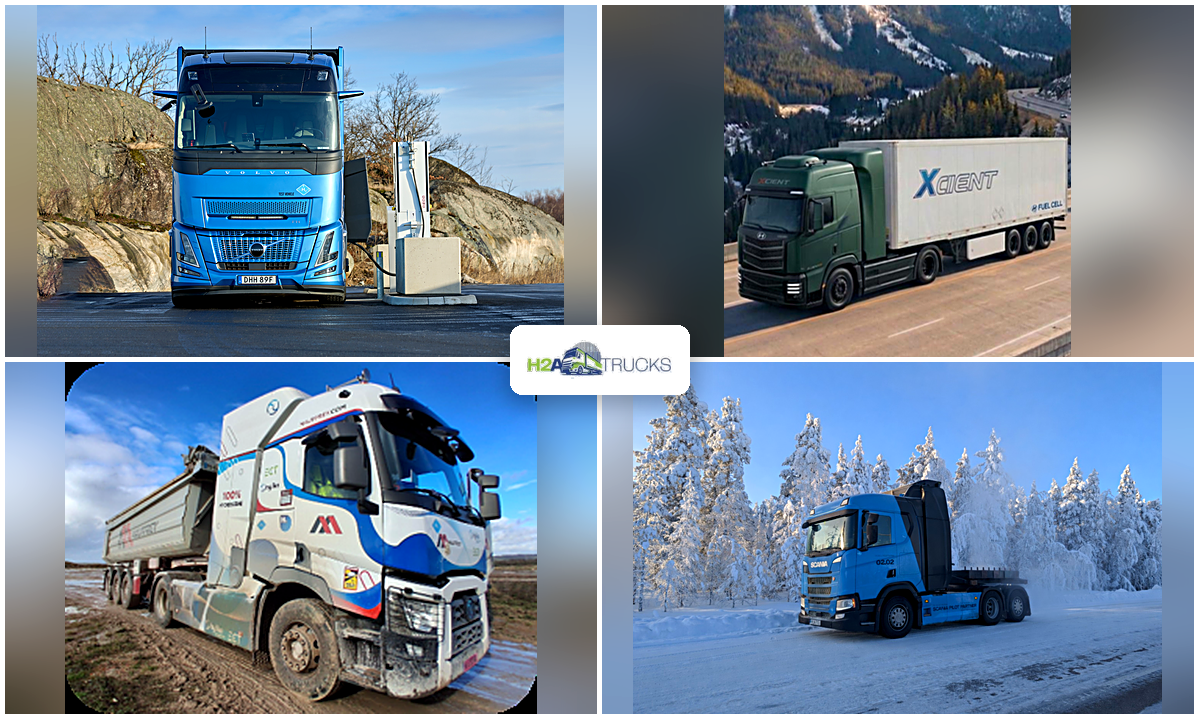
The four truck manufacturers involved in the project – Volvo, Scania, Hyundai and Hyliko – each presented an overview of their fuel cell electric truck technology, testing activities and deployment status.
Volvo Group presented its three-path strategy for decarbonisation, spanning battery-electric, alternative-fuel combustion, and fuel cell electric vehicles. Its Fuel Cell Electric truck, first showcased in 2022 and tested on public roads since 2023, is fitted with a cellcentric fuel cell system delivering 300 kW from two 150 kW units, alongside 50 kg of hydrogen storage at 700 bar for a range of more than 600 kms. Volvo reported ongoing performance and climate testing, including recent Arctic trials carried out jointly with the inauguration of a new hydrogen refuelling station, ahead of deployment under H2AccelerateTRUCKS.
Scania Pilot Partner presented its H2-FCEV, a zero-emission platform combining a battery-electric base with a hydrogen fuel cell range extender, offering up to 1,000 km of range depending on use, with a fuel cell system delivering up to 150–300 kW and 56 kg of hydrogen storage at 700 bar. The company confirmed that winter testing in Kiruna, Sweden has been completed and validated, and that a first generation of 15 vehicles is being rolled out in 2026 across Norway, Switzerland, Belgium and the UK in regional and long-haulage applications. A next-generation FCEV, targeting improved range and an updated fuel cell system supplied by Toyota, is planned for 2027-2029 with an expected fleet of around 35 vehicles in Europe.
Hyundai Hydrogen Mobility presented its vision to lead the decarbonisation of heavy goods transport through fuel cell drivetrains, drawing on nearly 30 years of fuel cell R&D and more than 21 million kilometres of truck and bus operation across Europe to date. The company reported that more than 180 units of its XCIENT Fuel Cell trucks have been retailed, supported by a European after-sales network of four technical training centres and more than 130 certified technicians.
Hyliko presented its integrated hydrogen mobility ecosystem in France, covering vehicles, hydrogen refuelling infrastructure and after-sales service. The company reported that its first customers have driven more than 300,000 km since June 2024, and that its Generation 2 vehicles, first presented at Solutrans 2025, are now entering operation.
From technology development to the practicalities of operation
The presentations prompted a wide-ranging discussion, with participants focusing on the issues that will matter most when fuel cell electric trucks enter regular commercial operation.
Refuelling was one of the topics discussed, with OEMs reporting current refuelling times of around 10–12 minutes and new technology expected to bring this below 10 minutes.
Cost remains another important consideration. Panellists identified fuel cell systems as an area with significant potential for cost reductions as production scales up, while also highlighting the need for more affordable green hydrogen.
Participants also raised homologation, where country-specific requirements on vehicle weight and length can extend approval timelines to several months. Increasing cybersecurity certification requirements are adding another consideration.
The discussion also returned to the project itself, including its restructuring and the key role of the Clean Hydrogen Partnership funding for maturing the market for fuel cell electric trucks in Europe. Dr Møller-Holst confirmed that all the 125 trucks are expected to be on the road by spring 2028, with funding supporting R&D and deployment according to the maturity of each OEM’s technology. All four manufacturers confirmed they would be able to fulfil larger orders as the market develops.
Next steps
A second End User Group meeting is planned once a significant share of the fuel cell electric truck fleet has been deployed, tentatively in Q4 2027, at which OEMs and end users will present lessons learnt and initial performance data from real-world operation. Until then, the group will receive project updates twice a year.
Stakeholders interested in the deployment of fuel cell electric trucks are invited to follow the project via the project website and LinkedIn page.